





Instagram Automation in 2026: The Complete Guide to Safe Automation, AI Workflows, Meta APIs, and Choosing the Right Platform
Instagram automation isn't about replacing human conversations anymore. It's about responding faster, qualifying leads smarter, and creating experiences that still feel personal. The difference between good automation and spam isn't AI—it's how you use it.
Instagram has evolved from a photo-sharing platform into one of the world's largest customer acquisition channels. Today, creators launch courses, agencies generate leads, SaaS companies onboard users, coaches sell communities, and e-commerce brands recover abandoned conversations—all through Instagram Direct Messages.
As businesses increasingly rely on Instagram for growth, one question appears repeatedly:
Which Instagram automation platform should I choose, and is it still safe in 2026?
The answer isn't as simple as comparing features.
Many businesses still assume all automation tools work the same way. They don't. Some platforms operate entirely through Meta's official APIs, while others rely on browser automation or reverse-engineered methods. The difference affects account safety, feature availability, reliability, and long-term sustainability.
This guide goes beyond feature lists. Instead of asking "Which platform has more buttons?", we'll answer the questions that actually matter:
-
What can Instagram automation legally do today?
-
How does the official Meta API work?
-
Which platforms are safest for businesses?
-
What do creators actually value after using these tools?
-
Which platform fits different business models?
-
Where is AI changing Instagram automation next?
By the end, you should be able to choose a platform based on your business—not marketing claims.
Why Instagram Automation Looks Different Today
A few years ago, "Instagram automation" usually meant bots.
They followed users automatically.
Liked posts.
Left generic comments.
Sent mass direct messages.
Those techniques briefly produced growth but eventually created a poor experience for users. As Instagram matured, Meta tightened its platform policies and restricted many unofficial automation methods.
Today's automation landscape is fundamentally different.
Modern platforms focus on conversation automation, not account manipulation.
Instead of pretending to be a human, they help businesses respond consistently when users intentionally engage—for example, by sending a message, commenting on a post, replying to a Story, or clicking an advertisement.
That shift changed the industry.
Automation is no longer about gaming Instagram's algorithm. It's about reducing response time, improving lead qualification, and maintaining conversations at scale.
Automation Isn't Replacing Humans—It's Filtering Conversations
One misconception appears repeatedly among new businesses:
"Automation means customers are talking only to bots."
Good automation doesn't eliminate people.
It delays human involvement until it becomes valuable.
Imagine a coaching business receiving 500 direct messages every day.
Without automation:
-
Every question receives manual attention.
-
Response times increase.
-
Leads lose interest.
-
Team members answer the same questions repeatedly.
With intelligent automation:
-
FAQs receive immediate responses.
-
Pricing information is delivered automatically.
-
Interested users are qualified.
-
High-intent conversations reach a human faster.
Automation becomes the receptionist—not the salesperson.
Understanding Meta's Official API
Every serious automation platform today eventually depends on one thing:
Meta's official APIs.
These APIs provide approved ways for software platforms to communicate with Instagram Business accounts.
Instead of controlling your browser or pretending to be you, an API acts like a secure communication channel.
When someone sends a direct message to your Instagram Business account, Meta allows approved applications to receive that message and respond within defined rules.
This distinction matters more than most businesses realize.
Why APIs Matter
Imagine two delivery companies.
One has permission to enter your building.
The other climbs through your window.
Both may deliver the package today.
Only one is likely to keep working tomorrow.
Official APIs provide:
-
Stable integrations
-
Better security
-
Policy compliance
-
Long-term reliability
-
Lower risk of account restrictions
Unofficial automation methods often break whenever Instagram changes internal systems.
Businesses relying on unofficial tools frequently experience interrupted workflows, login issues, or unexpected failures.
Official vs Unofficial Automation
| Official Meta API | Unofficial Automation |
|---|---|
| Uses Meta-approved APIs | Mimics user actions |
| Business accounts only | Often works with personal accounts |
| Stable integrations | More likely to break after updates |
| Lower policy risk | Higher compliance risk |
| Long-term solution | Short-term workaround |
| Preferred for businesses | Often used for growth hacks |
This doesn't automatically make every API platform "better."
It simply means businesses should understand how their automation actually operates before trusting it with customer communication.
Types of Instagram Automation
Automation today extends far beyond automatic replies.
The best platforms combine multiple workflows into a connected customer journey.
Comment-to-DM Automation
Someone comments:
"Guide"
The platform automatically sends:
"Thanks! Here's your download."
Simple.
Fast.
Effective.
Many creators use this to distribute lead magnets without asking users to manually message first.
Keyword Automation
Users send words like:
-
Pricing
-
Demo
-
Course
-
Start
Automation detects the keyword and triggers an appropriate conversation.
Done correctly, this feels natural because users intentionally requested information.
Story Reply Automation
Instagram Stories often generate high engagement but disappear after 24 hours.
Automation allows businesses to respond immediately when users reply to Story content.
This creates faster conversations while interest is still high.
AI-Assisted Conversations
Traditional automation follows predefined flows.
Modern platforms increasingly combine those flows with AI.
Instead of matching exact keywords, AI attempts to understand user intent.
For example:
User:
"Do you have something for small agencies?"
Instead of failing because "agency" wasn't configured exactly, AI can recognize the intent and guide the conversation appropriately.
This doesn't replace structured workflows—it complements them.
The Biggest Mistake Businesses Make
Many buyers compare automation tools using feature checklists.
They ask:
-
Does it support comments?
-
Does it support keywords?
-
Does it have AI?
-
Does it integrate with CRM?
Those questions matter.
But they ignore the more important one:
How does this platform fit the way my business actually communicates?
A solo creator selling digital products has very different needs from a marketing agency managing 30 client accounts.
Similarly, an e-commerce brand handling thousands of support inquiries values reliability differently than a coach qualifying premium leads.
Choosing the "best" platform without considering your workflow often leads to unnecessary complexity—or missing features that genuinely matter.
Think Beyond Features
The strongest automation platforms don't simply automate Instagram.
They become part of a broader customer journey.
For example:
Instagram Comment
        ↓
Automatic DM
        ↓
Lead Qualification
        ↓
Email Capture
        ↓
CRM
        ↓
Sales Team
        ↓
Customer
Notice that Instagram is only the beginning.
The real value comes from what happens after the first interaction.
Editorial Note: A common pattern among experienced creators and agencies is that they eventually stop asking, "Which automation tool has the most features?" Instead, they ask, "Which platform removes the most manual work without making conversations feel robotic?" That shift in thinking often leads to better long-term decisions than comparing feature lists alone.
What Makes an Instagram Automation Platform Worth Paying For?
Most comparison articles rank platforms by counting features.
-
Unlimited keywords
-
AI replies
-
CRM integration
-
Flow builder
-
Analytics
-
Team members
Those checklists look impressive but rarely answer the question businesses actually have:
Will this platform save me time every single day without making customer conversations feel robotic?
A platform with 100 features that only uses 10% of them creates unnecessary complexity. On the other hand, a platform focused on solving one problem exceptionally well often delivers better results than an all-in-one solution packed with features most businesses never touch.
Instead of looking at marketing pages, let's evaluate Instagram automation platforms using five practical criteria.
| Evaluation Criteria | Why It Matters |
|---|---|
| Reliability | Downtime means missed leads and delayed responses. |
| Ease of Setup | Complex automation often remains unused. |
| AI Quality | AI should understand intent, not just keywords. |
| Integration Ecosystem | CRM, Google Sheets, Slack, Calendly, email, and webhooks extend automation beyond Instagram. |
| Pricing Scalability | Costs should grow with business value, not become a burden as contacts increase. |
Comparing Popular Instagram Automation Platforms
Every platform approaches automation differently. Some focus on creators, some on agencies, while others try to become complete customer communication platforms.
The right choice depends less on feature count and more on how closely a platform matches your workflow.
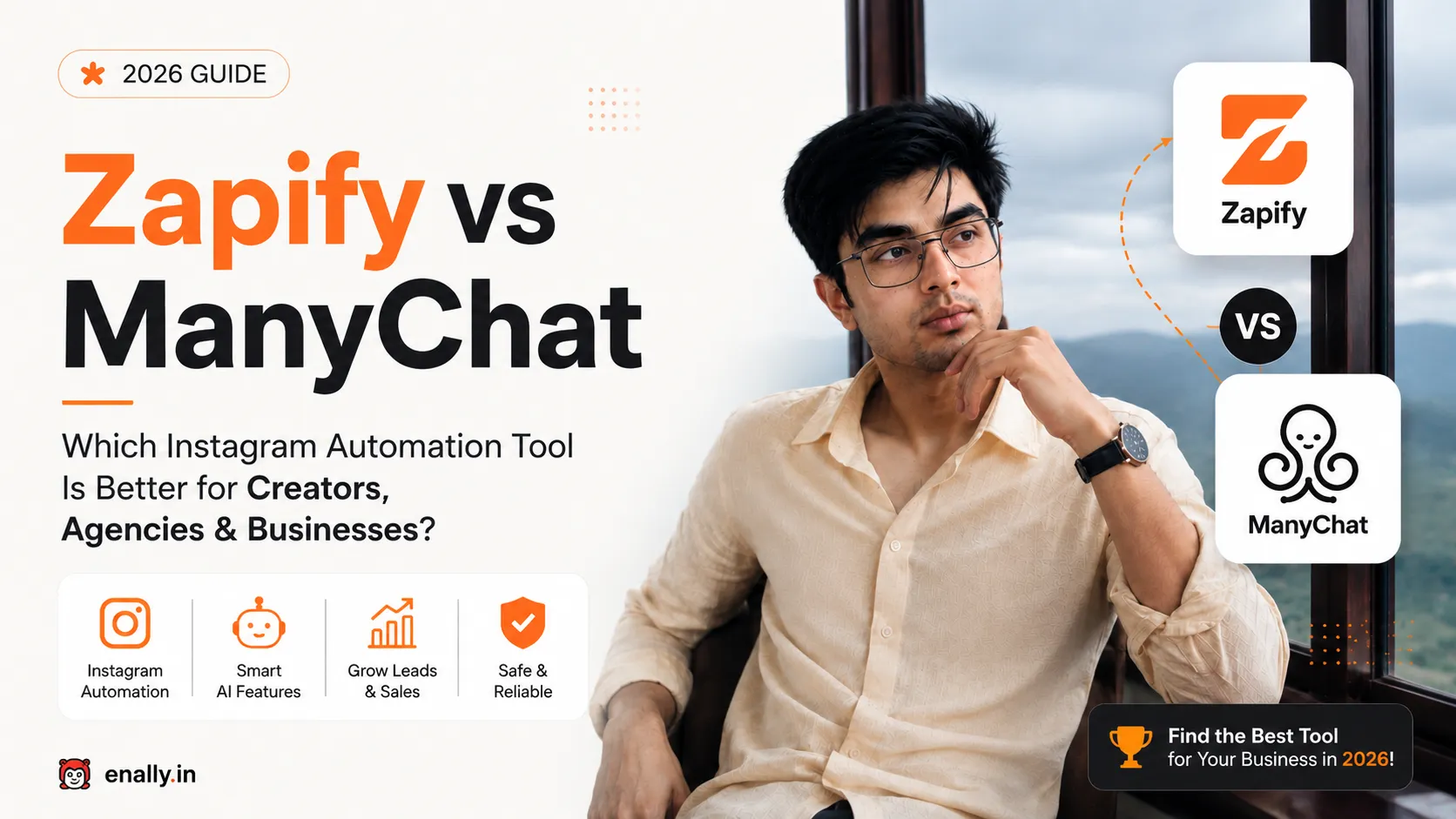
ManyChat
ManyChat remains one of the most recognized names in conversational marketing.
Originally built for Facebook Messenger, it gradually expanded into Instagram automation and now supports multiple communication channels.
Best For
-
Established creators
-
Coaches
-
Digital product sellers
-
Marketing teams
-
Multi-channel businesses
Strengths
-
Mature visual flow builder
-
Large integration ecosystem
-
Reliable Meta API implementation
-
Strong documentation
-
Large user community
Limitations
As businesses grow, pricing can increase significantly because costs often scale with contacts rather than actual automation usage.
For smaller creators this isn't usually a problem.
For businesses managing tens of thousands of contacts, pricing becomes an important consideration.
Where ManyChat Excels
Imagine launching a free guide.
Someone comments:
"Guide"
ManyChat can automatically:
-
Send a DM
-
Collect an email
-
Tag the lead
-
Add them to a CRM
-
Notify the sales team
-
Trigger future follow-ups
This end-to-end workflow is where ManyChat continues to stand out.
Zapify
Rather than trying to automate every social platform, Zapify focuses heavily on Instagram workflows.
This narrower focus changes how the product feels.
Instead of becoming another marketing automation platform, Zapify positions itself closer to an Instagram operating system.
Best For
-
Instagram-first businesses
-
Agencies
-
Coaches
-
Course creators
-
Personal brands
Strengths
-
Instagram-focused interface
-
AI-powered conversation assistance
-
Official Meta API approach
-
Modern user experience
-
Lower learning curve for Instagram users
Potential Trade-offs
Businesses looking for complex cross-channel automation may still need external integrations for broader workflows.
Practical Scenario
A creator posts:
"Comment 'START' and I'll send you the template."
Instead of manually replying to hundreds of comments, Zapify automatically delivers the resource through Instagram Direct Messages while continuing the conversation if the user asks follow-up questions.
The automation feels conversational rather than transactional.
Chatfuel
Chatfuel has existed for years and built a strong reputation through Messenger automation before expanding into Instagram.
Its biggest advantage is stability.
Large businesses often value predictable workflows more than experimental AI features.
Strengths
-
Enterprise experience
-
Stable automation
-
Reliable integrations
-
Strong chatbot capabilities
Considerations
Its interface sometimes feels more workflow-oriented than conversation-oriented, making it slightly less approachable for beginners compared to newer products.
LinkDM
LinkDM takes a lighter approach.
Instead of becoming an enterprise automation platform, it focuses on helping creators capture Instagram engagement more efficiently.
For solo creators, this simplicity can actually become an advantage.
Less configuration often means faster implementation.
MobileMonkey
MobileMonkey was among the early conversational marketing platforms.
Although still capable, many businesses now compare it against newer AI-focused platforms offering more modern interfaces and stronger Instagram-first experiences.
AI Is Changing Automation Faster Than Features
A few years ago, automation depended almost entirely on keyword matching.
Example:
User:
Pricing
↓
Automation:
Here's our pricing.
Simple.
Predictable.
But fragile.
If the customer typed:
How much does it cost?
↓
No response.
Modern AI systems attempt to understand intent instead of exact words.
That dramatically changes customer experience.
Traditional Automation
Keyword
      ↓
Matching Rule
      ↓
Predefined Response
AI-Assisted Automation
Customer Message
        ↓
Intent Detection
        ↓
Context Analysis
        ↓
Knowledge Base
        ↓
Relevant Response
The workflow becomes more flexible while still allowing businesses to maintain control through predefined rules.
The Community's Biggest Frustrations
After reviewing recurring discussions across creator communities, agencies, and marketing groups, several themes appear repeatedly regardless of platform.
Pricing That Doesn't Scale Well
Businesses often begin with only a few hundred contacts.
Automation feels inexpensive.
Months later:
-
20,000 contacts
-
Multiple campaigns
-
Higher subscription tiers
Suddenly automation costs become part of monthly operational expenses rather than marketing experiments.
Businesses should evaluate long-term pricing—not just introductory plans.
Automation That Feels Robotic
Customers immediately recognize generic responses.
Examples like:
Thanks for your message!
We appreciate your interest!
Please wait while we connect you.
feel automated.
Modern AI should sound closer to a knowledgeable assistant than a scripted chatbot.
Complex Flow Builders
Visual workflow builders look impressive.
But many businesses never use 80% of available features.
Simple workflows often outperform complicated decision trees because they're easier to maintain and debug.
Comparing Core Capabilities
| Feature | ManyChat | Zapify | Chatfuel | LinkDM |
|---|---|---|---|---|
| Official Meta API | ✅ | ✅ | ✅ | Varies by implementation |
| AI Replies | Good | Strong Focus | Good | Basic |
| Flow Builder | Excellent | Good | Excellent | Simple |
| Learning Curve | Medium | Low | Medium | Low |
| CRM Integrations | Extensive | Growing | Extensive | Limited |
| Agency Features | Strong | Strong | Strong | Moderate |
| Creator Friendly | Excellent | Excellent | Good | Excellent |
No single platform dominates every category.
Each reflects a different product philosophy.
Which Platform Fits Your Business?
| Business Type | Recommended Approach |
|---|---|
| Solo Creator | Simplicity matters more than enterprise features. |
| Course Creator | AI qualification combined with lead capture delivers the highest value. |
| Marketing Agency | Multi-client management and CRM integrations become essential. |
| SaaS Company | Automation should qualify leads before scheduling demos. |
| E-commerce Brand | Fast support, order updates, and product recommendations matter most. |
Notice that the recommendation isn't tied to a specific brand.
Business workflow should always drive platform selection—not marketing promises.
Features Most Businesses Never Ask About
When comparing platforms, businesses often overlook practical questions that become important after deployment.
Can conversations be handed over to a human instantly?
Automation should disappear when human expertise is needed.
Can workflows be updated without breaking active campaigns?
Frequent changes are inevitable as businesses grow.
Does AI remember previous context?
Context-aware conversations reduce repetitive questions and improve customer experience.
How easy is troubleshooting?
A workflow that takes five minutes to debug is far more valuable than one packed with advanced features that nobody understands six months later.
Does the platform evolve quickly?
Instagram changes frequently.
Platforms that release updates consistently tend to adapt faster to new Meta capabilities, AI improvements, and messaging features.
Looking Beyond Features
The automation industry is moving away from rule-based systems toward intelligent assistants that understand intent, recommend actions, summarize conversations, and assist human operators instead of replacing them.
Choosing a platform today isn't just about automating Instagram replies.
It's about selecting software that can continue adapting as AI becomes a standard part of customer communication rather than an optional feature.
Where Instagram Automation Is Heading Next
Automation has gone through three distinct phases.
The first was rule-based automation, where every workflow depended on predefined keywords. Businesses spent hours creating decision trees, but the experience often broke when users phrased questions differently.
The second phase introduced visual workflow builders. Platforms made automation more accessible by allowing users to drag and connect conversation blocks without writing code.
We're now entering the third phase—AI-native automation.
Instead of building every possible conversation manually, businesses define objectives while AI understands intent, drafts responses, summarizes conversations, qualifies leads, and knows when to involve a human.
The shift isn't from humans to AI. It's from repetitive tasks to intelligent assistance.
Why "AI Agents" Are the Next Big Step
Most automation tools today still follow a trigger-and-response model.
Comment
      ↓
Trigger
      ↓
Send DM
      ↓
End
AI agents change that completely.
Instead of following a fixed path, an AI agent can:
-
Understand what the user is trying to achieve.
-
Ask follow-up questions naturally.
-
Search a product knowledge base.
-
Book appointments.
-
Recommend products.
-
Escalate complex conversations to humans.
In other words, automation becomes less like a chatbot and more like a digital team member with defined responsibilities.
Automation Should Feel Invisible
The best automation is the one customers don't notice.
Think about the last time you contacted a business.
If the response arrived instantly, answered your question correctly, and seamlessly handed you over to a human when necessary, you probably didn't stop to think whether AI was involved.
That's the goal.
Good automation removes friction without announcing itself.
Common Mistakes Businesses Make
After evaluating how businesses implement Instagram automation, several recurring mistakes appear regardless of platform.
Mistake 1: Automating Everything
Many businesses assume every conversation should be automated.
It shouldn't.
Automation is excellent for:
-
FAQs
-
Lead qualification
-
Appointment booking
-
Resource delivery
-
Initial support
But it shouldn't replace:
-
Complex customer complaints
-
Refund discussions
-
Sensitive conversations
-
High-value negotiations
Human judgment still matters.
Mistake 2: Writing Robotic Messages
Customers immediately recognize messages that sound copied from a template.
For example:
❌
Thank you for contacting us. Your request has been received successfully.
Compare that with:
✅
Thanks for reaching out! 👋 What can I help you with today?
The second feels conversational without pretending to be human.
Small differences create better experiences.
Mistake 3: Ignoring Conversation Data
Every automated conversation reveals customer behavior.
Questions like:
-
What do people ask most?
-
Where do they leave the conversation?
-
Which keywords convert better?
-
Which campaign generates better leads?
These insights are often more valuable than the automation itself.
Businesses that regularly review conversation analytics improve both automation and marketing simultaneously.
Mistake 4: Building Massive Workflows Too Early
Some teams spend weeks designing enormous automation flows before talking to real customers.
Start simple.
Launch.
Observe.
Improve.
Automation should evolve with customer behavior—not assumptions.
Choosing the Right Platform: A Decision Framework
Instead of asking:
"Which platform is the best?"
Ask these questions.
If you're a creator
Do you primarily need:
-
Lead magnets?
-
Course sales?
-
Community onboarding?
Choose simplicity over enterprise complexity.
If you're an agency
Prioritize:
-
Multi-client management
-
Team collaboration
-
CRM integrations
-
Reporting
Your workflow matters more than AI features alone.
If you're an e-commerce business
Look for:
-
Product recommendations
-
Order support
-
Customer service automation
-
Cart recovery integrations
If you're a SaaS company
Focus on:
-
Lead qualification
-
Demo booking
-
CRM synchronization
-
AI-assisted sales conversations
Security Checklist Before Connecting Any Platform
Before authorizing access to your Instagram account, verify the following.
| Checklist | Why It Matters |
|---|---|
| Uses Meta-approved authentication | Reduces account risk and improves reliability. |
| Requests only necessary permissions | Limits unnecessary access to business data. |
| Supports secure team access | Helps agencies manage accounts safely. |
| Provides audit logs or conversation history | Useful for troubleshooting and compliance. |
| Offers active product updates | Indicates continued support as Meta evolves. |
Security is often ignored until something goes wrong.
Treat your Instagram account like any other critical business asset.
How to Evaluate New Automation Platforms
New AI-powered platforms appear almost every month.
Before switching, ask:
-
Does this platform solve a real problem or just add AI to its marketing?
-
Will my team actually use these features?
-
Can I migrate easily if needed?
-
Is the pricing sustainable as my business grows?
-
Does the product evolve regularly?
A polished landing page doesn't guarantee a mature product.
Look beyond feature lists and evaluate long-term fit.
Key Takeaways
-
Instagram automation has evolved from spam-like bots to customer experience platforms.
-
Official Meta APIs provide a more reliable foundation for long-term business automation.
-
The best platform depends on workflow—not popularity.
-
AI improves conversations but doesn't replace thoughtful customer support.
-
Simple, well-designed automations often outperform overly complex workflows.
-
Businesses should evaluate scalability, security, integrations, and support—not just feature counts.
-
Conversation analytics are as valuable as automation itself because they reveal customer intent.
-
AI agents are likely to become the next evolution of Instagram automation by combining conversation, decision-making, and business workflows.
Frequently Asked Questions
Is Instagram automation allowed?
Yes, when it follows Meta's platform policies and uses supported APIs for eligible business accounts. Avoid tools that promise unrealistic growth through automated follows, likes, or mass messaging.
Can AI completely replace customer support?
No.
AI is excellent at handling repetitive questions, qualifying leads, and providing instant responses, but complex issues, complaints, and relationship-building conversations still benefit from human involvement.
Which businesses benefit the most?
Creators, agencies, coaches, SaaS companies, education businesses, and e-commerce brands all benefit from automation when they receive a high volume of repetitive inquiries.
Should I choose a platform with the most features?
Not necessarily.
Choose the platform that best fits your workflow. A simpler product that your team uses consistently often creates more value than an advanced platform with features that remain untouched.
Final Thoughts
Instagram automation is no longer about sending automatic replies—it's about designing better customer experiences.
Businesses that succeed over the next few years won't be the ones with the most complicated workflows. They'll be the ones that combine AI, automation, and human expertise in a way that feels fast, helpful, and trustworthy.
As Meta continues expanding its messaging ecosystem and AI capabilities mature, automation platforms will shift from being simple workflow builders to intelligent assistants that understand context, coordinate actions, and help teams deliver better conversations at scale.
The question is no longer whether to automate Instagram.
The real question is how thoughtfully you're willing to automate it.