





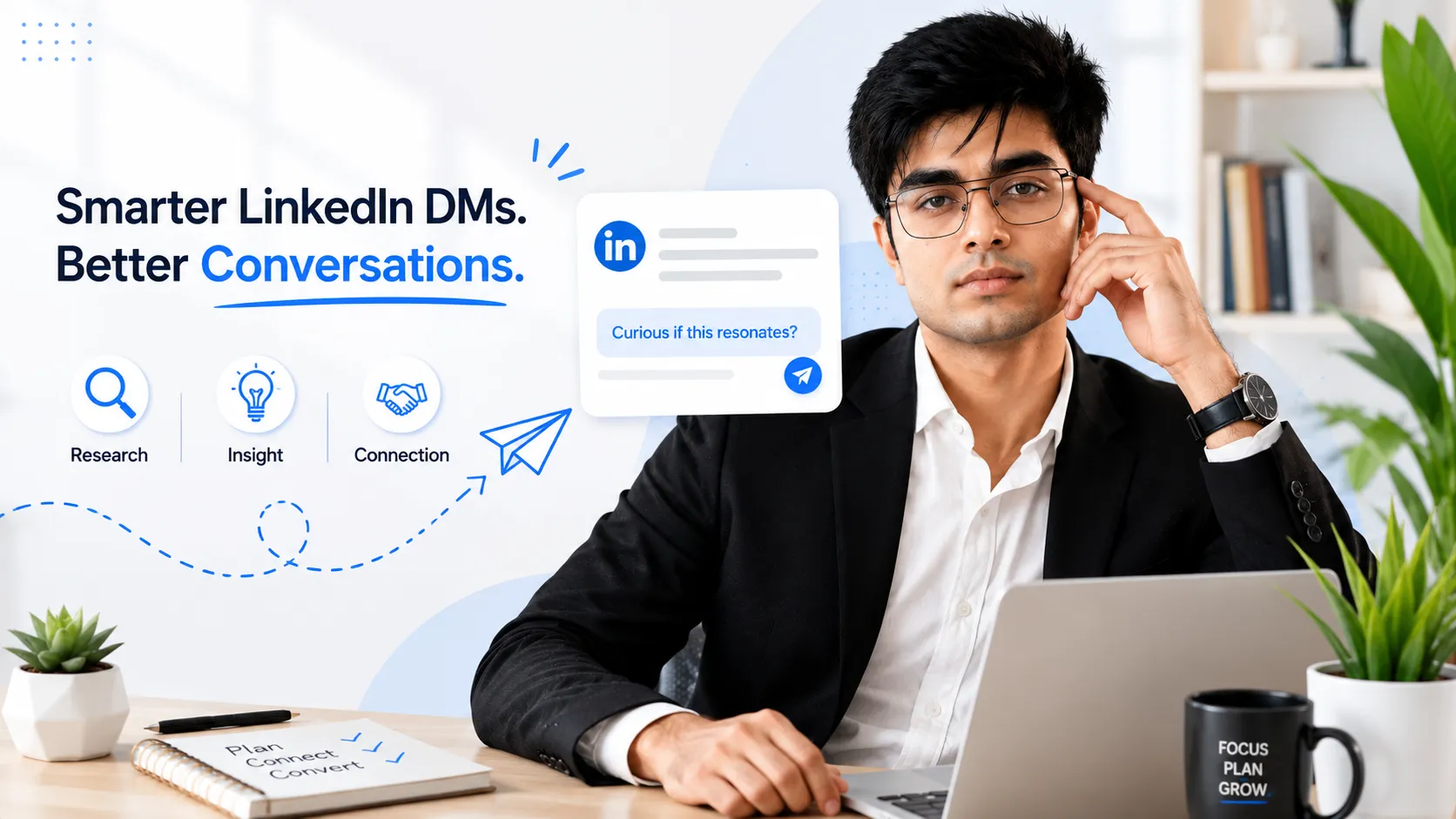
LinkedIn DM Framework: How to Generate High-Quality B2B Leads Without Sounding Like a Salesperson
Why Most LinkedIn Outreach Fails
Every day, founders, consultants, agencies, and freelancers send hundreds of LinkedIn messages hoping to generate leads.
Most of those messages are ignored.
Not because the offer is bad.
Not because the prospect isn't interested.
But because the sender tries to sell before building trust.
Consider these two examples:
Typical Cold DM
Hi John, I help businesses grow through digital marketing and web development. Would you be interested in a free consultation?
Insight-Based DM
Hi John, saw your team recently expanded into the UAE market. Many companies at this stage struggle with localized lead generation and conversion tracking. Curious if that's something you're currently optimizing?
One feels like a mass blast.
The other feels like a genuine conversation.
That's the difference.
The Psychology Behind High-Reply LinkedIn Messages
People don't respond to services.
People respond to relevance.
Before someone considers your solution, they need to believe:
-
You understand their business
-
You understand their challenges
-
You're not sending the same message to everyone
-
The conversation is worth their time
Modern LinkedIn outreach is less about pitching and more about demonstrating understanding.
"Lead with insight, not an offer."
The insight earns the reply.
The offer earns the meeting.
The Four-Part LinkedIn DM Structure
The most effective outreach messages typically follow a simple framework.
| Component | Purpose |
|---|---|
| Hook | Show you've done your research |
| Insight | Demonstrate understanding |
| Offer | Present a clear outcome |
| CTA | Encourage a low-friction response |
Framework Template
Hi [Name],

I saw your recent [update/activity].

Noticed that many [role] at this stage often face [specific challenge].

I help with [outcome] using [method].

Curious — is this something you're currently working on?
Step 1: Create a Strong Hook
Your opening sentence determines whether the rest of your message gets read.
Avoid generic introductions.
Weak Hook
Hi, I came across your profile.
Strong Hook
Saw your recent product launch announcement.
Other Hook Ideas
-
Recent funding round
-
New hiring announcement
-
New office opening
-
Product launch
-
Partnership announcement
-
Podcast appearance
-
LinkedIn post
-
Industry recognition
The goal is simple:
Prove this message was written specifically for them.
Step 2: Deliver a Relevant Insight
The insight section is the most important part of your message.
This is where you demonstrate expertise without sounding salesy.
Example
A startup founder who recently raised funding:
Many founders after a funding round focus heavily on growth, but often discover their website and conversion systems aren't ready to support increased traffic.
A SaaS company hiring salespeople:
Companies expanding sales teams often find lead qualification becomes a bottleneck before revenue becomes predictable.
Notice the difference.
You're not selling.
You're observing.
Step 3: Present Your Offer Clearly
Most people ruin outreach at this stage.
Instead of explaining features, explain outcomes.
Poor Offer
We provide custom web development, SEO services, PPC advertising, CRM integrations, analytics implementation, and marketing automation.
Better Offer
I help startups increase qualified inbound leads through conversion-focused websites and marketing automation.
Outcome first.
Process second.
Features last.
Proven Offer Frameworks
Turn Assets Into Outcomes
I help turn [existing asset] into [desired outcome].
Example:
I help turn underperforming websites into consistent lead-generation channels.
Remove The Pain
I help [role] achieve [result] without [common frustration].
Example:
I help founders generate more inbound leads without increasing ad spend.
Process-Based Positioning
I work with [audience] to achieve [result] using [specific process].
Example:
I work with SaaS companies to improve demo bookings using conversion-focused landing pages.
Step 4: Use a Soft Call-To-Action
A hard CTA often kills momentum.
Avoid
-
Book a call
-
Schedule a meeting
-
Here's my Calendly
-
Let's jump on Zoom
Use Instead
-
Curious if this resonates?
-
Is this something you're currently focused on?
-
Open to a quick conversation?
-
Interested in hearing how others are solving this?
The goal is a response.
Not an appointment.
Real Examples
Example 1: Web Development Agency
Hi Sarah,

Saw your team recently launched a new service page.

Many growing businesses struggle to convert website traffic into qualified inquiries after expansion.

I help improve conversion rates through landing page optimization and user experience improvements.

Curious if that's currently on your roadmap?
Example 2: SEO Consultant
Hi David,

Noticed your company has been publishing more content recently.

Many teams investing in content struggle to turn traffic into predictable lead flow.

I help improve organic lead generation through SEO and conversion-focused content strategy.

Is that something you're actively working on?
Example 3: SaaS Founder
Hi Mark,

Saw your recent announcement about expanding your product offering.

Many SaaS companies at this stage find onboarding and activation become larger growth constraints than acquisition.

I help improve user activation through product and funnel optimization.

Open to a quick conversation?
Finding High-Intent Leads On LinkedIn
Finding prospects is often more important than writing messages.
The best prospects are already experiencing problems your service solves.
Method 1: The Hiring Signal Strategy
Search LinkedIn for:
-
Hiring Developer
-
Hiring Designer
-
Hiring SEO Specialist
-
Hiring Growth Manager
-
Hiring Sales Representative
Why it works:
Companies that are hiring:
-
Have budget
-
Are growing
-
Have active priorities
-
Need execution help
Best Roles To Target
| Role | Buying Authority |
|---|---|
| Founder | High |
| Co-Founder | High |
| CEO | High |
| CTO | High |
| Marketing Director | Medium-High |
| Growth Lead | Medium |
Method 2: Website Audit Prospecting
One of the most effective lead generation methods.
Find companies with:
-
Slow websites
-
Poor mobile experience
-
Missing CTAs
-
Broken analytics
-
Weak SEO
-
Conversion issues
Then send a personalized observation.
Example:
Noticed your homepage takes several seconds to load on mobile and there's no visible booking CTA above the fold. Thought I'd mention it because it may be impacting conversions.
This approach immediately creates credibility.
Method 3: Stealth Startup Prospecting
Search LinkedIn for:
Stealth Startup
Visit company profiles.
Open the People tab.
Filter by:
-
Founder
-
CEO
-
Co-Founder
-
CTO
Why this works:
Stealth startups are often:
-
Building products
-
Raising capital
-
Hiring aggressively
-
Looking for partners
-
Purchasing services
Before most competitors discover them.
Method 4: Recently Funded Companies
Look for announcements containing:
-
Raised Seed Funding
-
Pre-Seed Funding
-
Series A Funding
-
Venture Backed Startup
Funding creates urgency.
New funding usually leads to spending on:
-
Website redesigns
-
Software development
-
Growth marketing
-
Automation
-
Hiring
Building A Daily LinkedIn Lead Generation System
Consistency beats volume.
Daily Activity Plan
| Activity | Target |
|---|---|
| New Connections | 50 |
| Website Audits | 20 |
| Personalized DMs | 20 |
| Follow-Ups | 15 |
| LinkedIn Comments | 20 |
Follow-Up Framework
Most opportunities are created in follow-ups.
Follow-Up #1
After 4–5 days:
Just wanted to follow up in case my earlier message got buried.
Follow-Up #2
After another week:
Thought this article might be relevant to the challenge I mentioned earlier.
Follow-Up #3
After another week:
No worries if timing isn't right. Happy to reconnect in the future.
Simple.
Professional.
Respectful.
Using AI For Personalized Outreach
AI can accelerate personalization when used correctly.
Recommended workflow:
-
Identify the prospect.
-
Review their recent LinkedIn activity.
-
Extract one relevant insight.
-
Generate a draft message.
-
Manually review before sending.
AI Prompt Template
You are a B2B copywriter.

Write a LinkedIn DM under 300 characters.

Target Audience: Founder
Industry: SaaS

Requirements:
- Professional
- Human
- Non-salesy
- Mention one recent activity
- Include one relevant insight
- Present one clear outcome-focused offer
- End with a soft CTA

No hype.
No emojis.
No buzzwords.
LinkedIn Outreach Metrics To Track
| Metric | Good Benchmark |
|---|---|
| Connection Acceptance Rate | 30%–50% |
| Reply Rate | 15%–40% |
| Positive Replies | 5%–15% |
| Meetings Booked | 2%–10% |
| Closed Deals | Depends on offer |
Track performance weekly.
Optimize based on actual results rather than assumptions.
Common Outreach Mistakes
| Mistake | Better Alternative |
|---|---|
| Pitching immediately | Start with an observation |
| Generic messaging | Personalize every message |
| Feature-heavy offers | Outcome-focused offers |
| Aggressive CTAs | Low-friction questions |
| No follow-up | Structured follow-up sequence |
| Targeting everyone | Focus on high-intent prospects |
The best LinkedIn outreach doesn't feel like outreach. It feels like the start of a valuable conversation.
Useful Resources
-
LinkedIn Sales Navigator: https://www.linkedin.com/sales
-
LinkedIn Search: https://www.linkedin.com/search
-
Hunter.io: https://hunter.io
-
Apollo.io: https://apollo.io
-
Crunchbase: https://www.crunchbase.com
-
BuiltWith: https://builtwith.com
-
SimilarWeb: https://www.similarweb.com
-
Clearbit: https://clearbit.com
Lead Generation Checklist
-
Identified a relevant prospect
-
Researched their recent activity
-
Found a meaningful insight
-
Wrote a personalized hook
-
Focused on outcomes
-
Included a soft CTA
-
Proofread the message
-
Scheduled follow-up
-
Tracked the result
-
Optimized based on responses