





Building One AI Agent Is Easy. Building Five That Work Together Is Where Things Get Interesting.
Most AI applications begin with a single prompt.
One model.
One response.
One job.
That works... until it doesn't.
The moment your application needs to research, reason, search documentation, write code, validate output, or communicate with another system, your "smart assistant" starts looking more like an overworked intern trying to do everyone's job.
One AI agent can answer questions. A team of AI agents can solve problems.
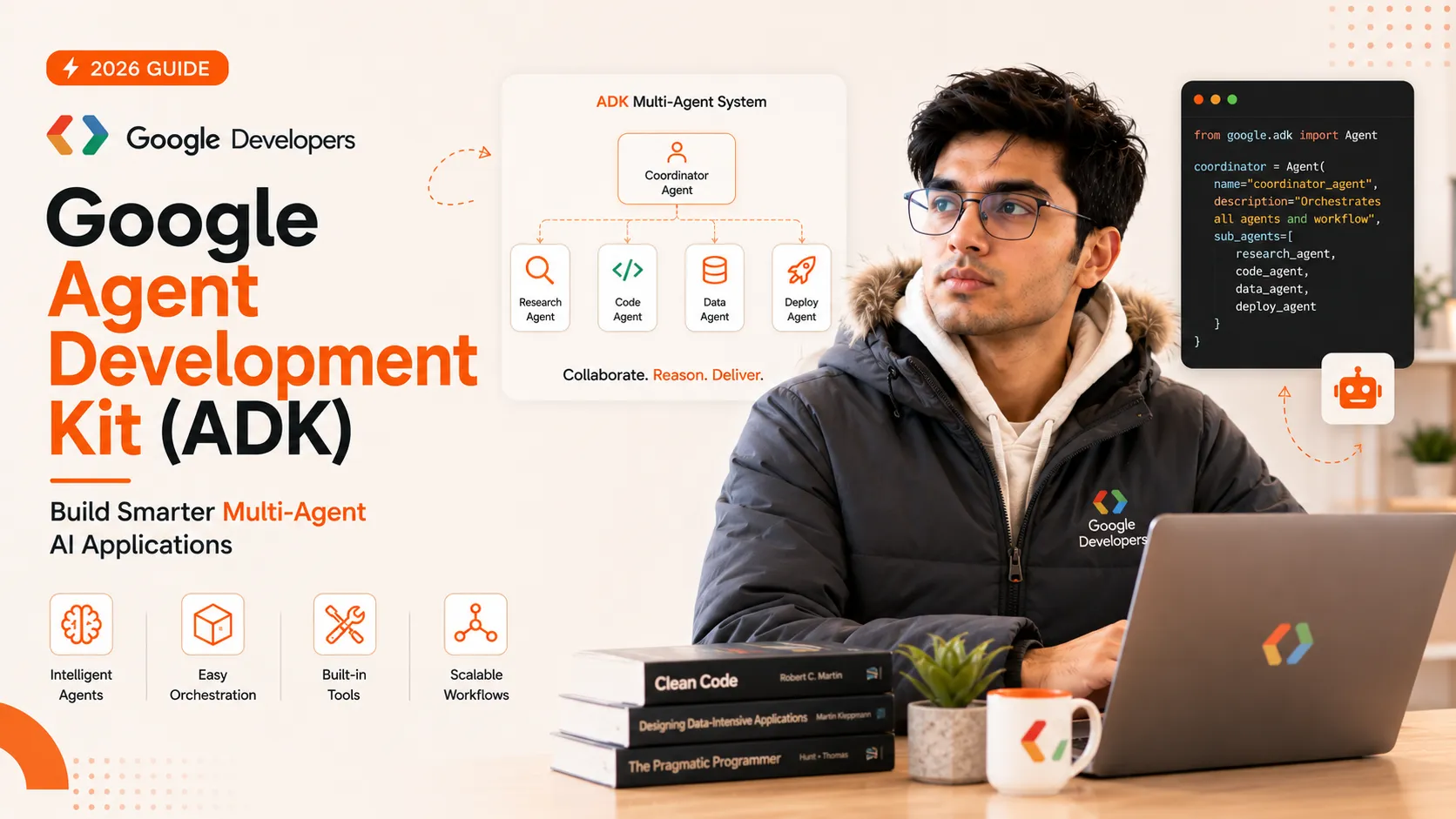
This is exactly the gap Google's Agent Development Kit (ADK) is designed to bridge.
Wait... What Exactly Is ADK?
Google ADK (Agent Development Kit) is an open-source framework for building multi-agent AI applications.
Instead of creating one massive AI assistant that tries to know everything, ADK encourages you to build multiple specialized agents that collaborate.
Think of it like a software engineering team.
Product Manager
        │
        ▼
Lead Agent
   ├──────────────┐
   ▼              ▼
Research       Coding
 Agent          Agent
   ▼              ▼
Testing       Documentation
 Agent          Agent
        ▼
   Final Response
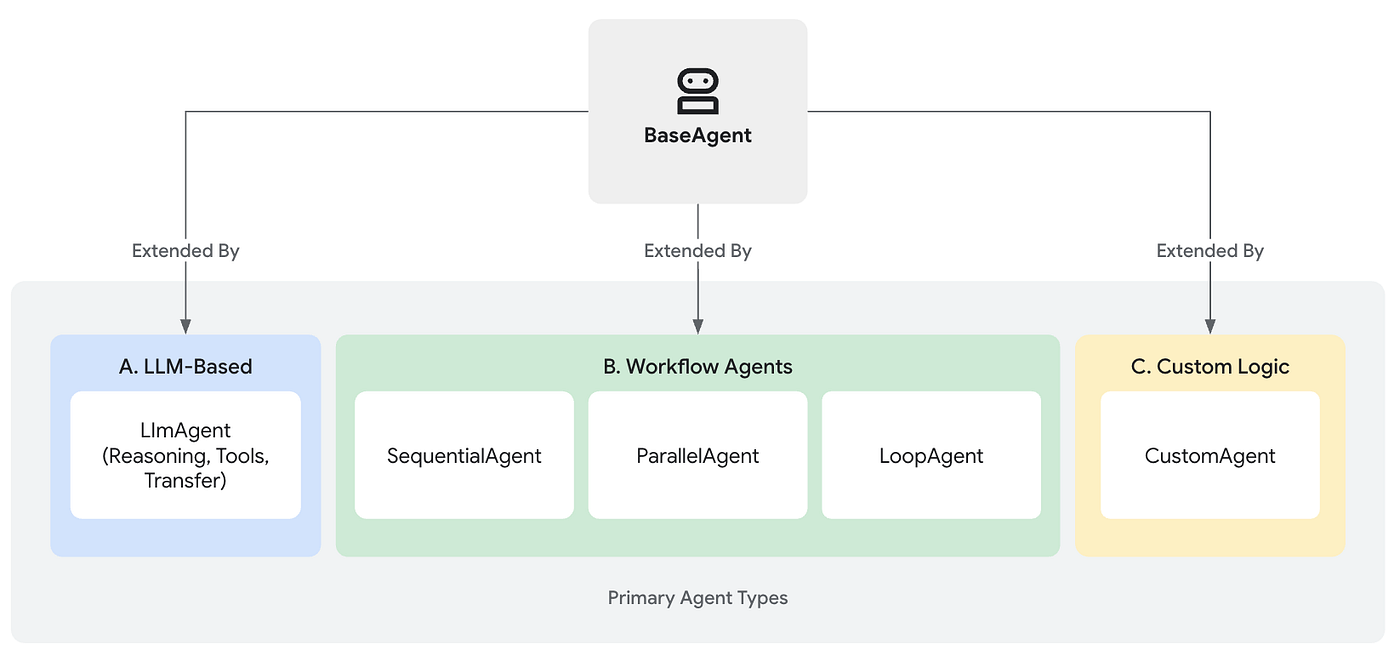
Each agent has one responsibility.
Nobody is pretending to be good at everything.
Ironically, that's exactly how good engineering teams work too.
Why One Giant Prompt Isn't the Future
Developers have become experts at writing prompts that resemble novels.
You are a senior developer,
product manager,
UI designer,
DevOps engineer,
security expert,
SEO specialist,
marketing consultant...
At some point, you're no longer writing prompts.
You're hiring imaginary employees.
Multi-agent systems replace that approach with specialized responsibilities.
Instead of asking one model to become ten experts, each agent focuses on one task and collaborates with others.
Understanding the ADK Architecture
At a high level, an ADK application looks something like this.
               User
                 │
                 ▼
          Coordinator Agent
      ┌──────────┼──────────┐
      ▼          ▼          ▼
 Research     Coding     Planning
   Agent       Agent       Agent
      │          │          │
      ▼          ▼          ▼
 Search API   GitHub API   Calendar
      │
      ▼
  Shared Context
      │
      ▼
 Final Response
Notice something interesting.
The user only talks to one entry point.
Behind the scenes, multiple agents communicate, exchange context, and complete independent tasks.
That orchestration is what makes multi-agent systems powerful.
Why Google Built ADK
Google already has powerful AI models.
So why create another framework?
Because building intelligent applications isn't just about generating text anymore.
Modern AI applications need to:
-
Call APIs
-
Search databases
-
Execute tools
-
Maintain memory
-
Delegate work
-
Verify outputs
-
Recover from failures
-
Coordinate multiple reasoning steps
That's an orchestration problem.
ADK focuses on solving orchestration rather than just text generation.
Anatomy of an ADK Agent
Every agent generally consists of four things.
Agent
├── Goal
├── Instructions
├── Tools
├── Memory
└── Decision Logic
The goal defines why the agent exists.
The tools define what it can do.
Memory helps it retain context.
Decision logic determines when to act.
Simple individually.
Powerful together.
Example: Building an SEO Audit Team
Instead of writing one huge prompt, imagine splitting responsibilities.
SEO Coordinator
│
├── Technical SEO Agent
├── Content Agent
├── Schema Agent
├── PageSpeed Agent
├── Accessibility Agent
└── Report Generator
Each agent analyzes one aspect.
The coordinator merges everything into a single report.
This approach scales much better than one enormous prompt trying to remember fifty instructions.
Your AI Shouldn't Memorize APIs
It Should Use Them.
One of ADK's biggest strengths is tool integration.
Instead of asking the model to "guess" information...
...it can actually retrieve it.
from google.adk.tools import Tool

search_tool = Tool(
    name="search_docs",
    description="Search developer documentation"
)
The model reasons.
The tool fetches facts.
That's a much healthier relationship than asking the AI to confidently hallucinate.
Multi-Agent Doesn't Mean More Complexity
It Means Better Separation of Responsibilities
Developers often assume more agents means more complexity.
Usually, the opposite happens.
Instead of maintaining one 700-line prompt...
Prompt.txt
────────────
742 lines
...you maintain multiple focused agents.
Research Agent

35 lines

────────────

Testing Agent

28 lines

────────────

Documentation Agent

22 lines
Smaller agents are easier to debug, test, and improve independently.
Communication Is Everything
Imagine these two conversations.
Without coordination
Research Agent
"I found the API."

Coding Agent
"I didn't know."

Testing Agent
"I tested something else."
Chaos.
Now compare it with coordinated messaging.
Research
↓

Shared Context
↓

Coding
↓

Testing
↓

Documentation
↓

User
Context becomes the language agents speak.
Building Your First Agent
A minimal agent definition looks surprisingly clean.
from google.adk.agents import Agent

assistant = Agent(
    name="research_agent",
    description="Searches documentation",
)
Of course, real applications grow beyond this.
But the important lesson is that the architecture stays understandable even as the system scales.
Real-World Applications
ADK isn't limited to chatbots.
It fits naturally into systems where different responsibilities need coordination.
Examples include:
-
AI coding assistants
-
SEO auditing platforms
-
Research copilots
-
Customer support automation
-
Financial analysis workflows
-
Healthcare documentation
-
Content generation pipelines
-
Internal enterprise assistants
-
Software testing automation
-
Project management copilots
Anywhere work can be divided, agents can collaborate.
The Hidden Superpower: Agent Reusability
One well-designed agent rarely stays in one project.
Imagine building a Documentation Agent.
Today it documents APIs.
Tomorrow it explains database schemas.
Next week it's generating release notes.
The surrounding workflow changes.
The agent itself often doesn't.
Reusable agents become building blocks rather than one-off scripts.
Common Mistakes Developers Make
Giving Every Agent Every Tool
Just because an agent can access twenty APIs doesn't mean it should.
Limit permissions.
Keep responsibilities focused.
Smaller decision spaces generally lead to more predictable behavior.
Creating Too Many Agents
If your application has twenty-three agents...
...you may have recreated corporate bureaucracy.
More agents don't automatically mean better architecture.
Sometimes three focused agents outperform fifteen confused ones.
Forgetting Shared Context
Agents that don't communicate eventually duplicate work.
Context isn't optional.
It's the backbone of orchestration.
Debugging Multi-Agent Systems
Traditional debugging asks:
Why did this function fail?
Agent debugging asks:
Which agent made this decision?
Which tool was called?
Which context was missing?
Which assumption became incorrect?
That shift changes how developers think about observability.
Why ADK Feels Familiar to Software Engineers
Good software has always been modular.
Frontend.
Backend.
Database.
Authentication.
Caching.
Logging.
Nobody builds all of that inside one giant function.
Multi-agent AI follows the same philosophy.
Different responsibilities.
Clear boundaries.
Well-defined communication.
Software engineering principles finally meet AI orchestration.
ADK + MCP = A Powerful Combination
Model Context Protocol (MCP) gives AI systems a standardized way to connect with external tools and data sources.
ADK provides the orchestration layer that decides which agent should use which tool, when, and why.
Together, they create a workflow where agents can:
-
Discover tools dynamically
-
Access structured context
-
Delegate tasks intelligently
-
Share results with other agents
-
Produce reliable, grounded responses
One framework organizes the team.
The other expands what that team can actually do.
"A good AI answers questions. A great AI knows when to ask another AI for help."
Key Takeaways
-
Multi-agent systems divide work instead of expanding prompts.
-
ADK focuses on orchestration rather than just generation.
-
Specialized agents are easier to maintain than giant prompts.
-
Shared context is essential for collaboration.
-
Tool integration makes responses more reliable.
-
Modular agents are reusable across projects.
-
ADK complements protocols like MCP by coordinating how agents interact with external capabilities.