





Meta Muse: The AI Agent That Can Actually Act
From answering questions to taking actions — and why permissions may become the most important layer in agentic AI
“The future of AI isn't prompting. It's permission.”
For years, most AI assistants have operated inside a relatively safe boundary: you ask a question, the model generates an answer, and you decide what happens next.
Meta’s new Muse changes that model.
Launched on September 8, 2026, Muse is designed as a personal AI agent that can work across the applications and services people use every day. Instead of simply telling you how to send an email, book a trip, fill out a form, or buy something, Muse is designed to perform those tasks on your behalf. (About Facebook)
That sounds like a natural evolution of AI.
Technically, it is much more significant.
The moment an AI can act, software architecture has to solve a problem that chatbots largely avoided:
What should the AI be allowed to do?
What Is Meta Muse?
Muse is Meta's personal AI agent built around the idea that an AI should be able to pursue goals rather than merely respond to individual prompts.
A traditional chatbot works roughly like this:
User
  ↓
Prompt
  ↓
AI
  ↓
Answer
  ↓
User takes action
An agent changes the loop:
User
  ↓
Goal
  ↓
AI plans
  ↓
AI uses tools
  ↓
AI takes actions
  ↓
AI evaluates progress
  ↓
Result
Muse is built for this second model.
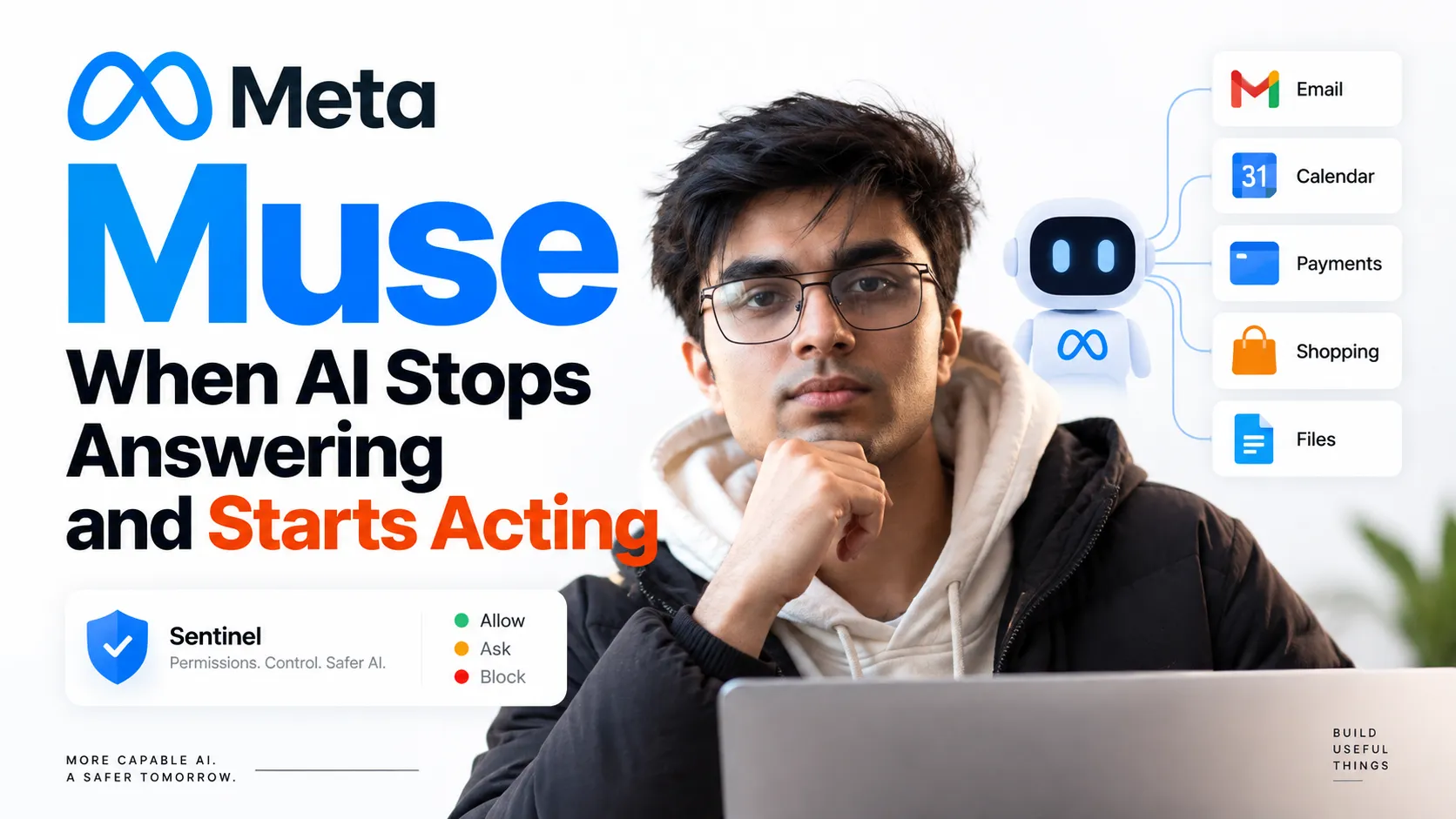
Meta says Muse can work across connected services such as email, calendars, shopping, payments, health and fitness, smart-home systems and other applications. It can also operate through a dedicated app and WhatsApp. (About Facebook)
The important distinction is not that Muse has a better chat interface.
It is that the model has access to an execution environment.
The Architecture Behind Muse
One of the most interesting parts of Muse is not the model itself.
It is the infrastructure surrounding the model.
Meta built Muse around a dedicated Muse Secure VM — an isolated Linux-based virtual machine containing the agent, its workspace, browser and connected data. The architecture separates the agent's runtime from security-sensitive components such as credentials and permission enforcement. (Meta AI Research)
A simplified mental model looks like this:
                    USER
                     │
                     ▼
                  MUSE AI
                     │
              proposes an action
                     │
                     ▼
                 SENTINEL
              permission layer
                │         │
             Allow      Ask user
                │         │
                ▼         ▼
          Connector     Approval
                │
                ▼
        External service
This separation is important.
The AI does not simply receive an API key and receive unrestricted access to everything that key can do.
Instead, Meta describes several separate security boundaries:
-
Muse decides what it wants to accomplish.
-
Sentinel determines whether a requested action is permitted.
-
Authd manages credentials.
-
Privsep controls where credential-capable code executes.
-
Sandboxed workers execute sensitive connector operations.
-
Network traffic is also evaluated at the security boundary. (Meta AI Research)
This is a fundamentally different approach from giving an LLM a collection of tools and hoping the model always uses them correctly.
Sentinel: The Most Important Part of Muse
The most interesting technical component may be Sentinel.
Meta describes Sentinel as a separate host-side agent and the sole permission authority for connector actions and network egress. Muse can propose an action, but Muse itself cannot grant that action permission. (Meta AI Research)
For example, imagine Muse wants to send an email.
The conceptual flow becomes:
Muse:
"I want to send this email."

        ↓

Sentinel:
"What connector?"
"Which action?"
"Which destination?"
"What scope?"
"What was the user's original intent?"

        ↓

Policy evaluation

        ↓

ALLOW / DENY / ASK USER
That distinction matters because an AI model should not be the final authority over its own permissions.
A model can make mistakes.
A model can misunderstand instructions.
A model can encounter malicious content.
A model can be manipulated through prompt injection.
And an agent can potentially encounter all three while holding access to real systems.
Separating intelligence from authorization is therefore one of the most important architectural ideas in Muse.
AI Agents Create a New Security Problem
Consider a normal chatbot.
A malicious webpage might trick the model into producing an incorrect answer.
That is bad.
Now consider an agent with access to:
-
your private email
-
your calendar
-
your documents
-
your browser
-
your payment methods
-
your accounts
A malicious webpage could potentially attempt to manipulate the agent into reading private information and sending it somewhere else.
This is the core danger behind prompt injection in agentic systems.
Security researcher Simon Willison describes a particularly dangerous combination as the “lethal trifecta”:
-
Access to private data
-
Exposure to untrusted content
-
The ability to communicate externally
When all three exist together, an attacker may attempt to manipulate an agent into exfiltrating private information. Meta explicitly discusses this threat in its Muse security architecture. (Meta AI Research)
This is why simply saying “the model is trained to resist prompt injection” is not enough.
The system needs protection below the model.
Defense in Depth Instead of Trusting the Model
Meta's approach is essentially defense in depth.
Muse combines model-level defenses with infrastructure-level restrictions.
External data entering the model context can be treated as untrusted. Meta also describes multiple prompt-injection classifiers, agentic red-teaming, sandboxing, credential isolation, network controls and human approval for higher-risk operations. (Meta AI Research)
The philosophy is simple:
Assume the agent will eventually make a mistake. Design the system so that mistake cannot automatically become a catastrophe.
That is an important shift in AI engineering.
Traditional application security often assumes that the application logic should make deterministic decisions.
Agentic software introduces probabilistic reasoning into the execution path.
The security architecture therefore has to compensate for that uncertainty.
Least Privilege Becomes Essential
Muse also applies a familiar security principle to AI:
least privilege.
If an agent only needs to read a calendar, it should not automatically receive permission to modify every calendar setting.
If it needs to read email, that does not mean it should automatically receive access to password-reset links and authentication tokens.
Meta says Muse separates read and write permissions where supported and adds finer-grained controls beyond traditional OAuth scopes. Its email connector also filters sensitive items such as one-time codes, password-reset links and login magic links. (Meta AI Research)
This gives us an important design principle for agentic applications:
Don't ask:

"What APIs can this agent access?"

Ask:

"What minimum capabilities does this agent need
to complete this specific task?"
That difference becomes increasingly important as agents gain more tools.
Human Approval Is Not a Failure
A common assumption about autonomous AI is that the best agent should require no human interaction.
Muse takes a more nuanced approach.
When Sentinel determines that an action requires approval, execution pauses and the user receives a specific approval request. Meta says these approvals can be scoped to a particular connector, destination and use case, with options such as one-time, task-scoped, session-scoped or time-bounded permissions. (Meta AI Research)
The goal is not:
Ask permission for everything.
Nor is it:
Let AI do everything.
It is:
Low risk → automate

Known safe action → automate

Sensitive action → ask

High-risk action → block or require stronger controls
This is a much more practical model for real-world AI agents.
Payments Are a Good Example
Payments demonstrate why permission architecture matters.
Meta says Muse requires human approval for purchases and can use a single-use payment number tied to a particular merchant, amount and limited validity period. At launch, Meta says it is using Stripe Link for this wallet functionality, with Shop Pay planned for later. (Meta AI Research)
That creates a useful security boundary.
Instead of:
Agent → permanent credit card → merchant
the system can work more like:
Agent
  ↓
Purchase request
  ↓
Security checks
  ↓
Human approval
  ↓
Scoped payment credential
  ↓
Merchant
If that temporary credential were exposed, its usefulness would be substantially constrained.
This is an example of a broader principle:
Don't rely only on the AI behaving correctly. Reduce the blast radius when it doesn't.
Muse Is More Than a Chatbot With Tools
Giving an LLM access to tools does not automatically create a robust agent.
A production agent needs an entire execution system around the model:
                    ┌──────────────┐
                    │   AI Model   │
                    └──────┬───────┘
                           │
                    Planning / Reasoning
                           │
                    ┌──────▼───────┐
                    │ Agent Runtime│
                    └──────┬───────┘
                           │
              ┌────────────┼────────────┐
              ▼            ▼            ▼
           Tools        Browser      Subagents
              │            │            │
              └────────────┼────────────┘
                           ▼
                       Sentinel
                           │
                 ┌─────────┴─────────┐
                 ▼                   ▼
              Allow               Approval
                 │                   │
                 └─────────┬─────────┘
                           ▼
                    External Systems
This is why agent engineering is increasingly becoming a systems problem rather than simply a prompt-engineering problem.
Where Muse Code Fits In
Meta's agent work also extends into software development.
Muse Code, introduced as a beta coding agent powered by Muse Spark, is designed to work across large repositories, plan changes, write code, validate results and coordinate persistent background agents. (Meta AI Research)
Muse Spark 1.3, released shortly before the personal Muse launch, is designed for longer-horizon agentic workflows where the model can use tools, work through conflicting information and maintain context across extended tasks. (Meta AI Research)
The connection is important.
The underlying direction is not simply:
better AI answers.
It is:
AI systems capable of sustained, tool-using work.
That makes the surrounding architecture — tools, permissions, memory, isolation, observability and approvals — increasingly important.
What Developers Should Learn From Muse
Muse provides a useful blueprint for anyone building an AI agent today.
1. Separate reasoning from authorization
The agent can request an action.
A separate policy layer should decide whether the action is permitted.
2. Never give the model unnecessary credentials
The model should not need to see API keys simply because its tools require them.
Use credential brokers, scoped tokens or server-side execution wherever possible.
3. Treat external content as hostile
Web pages, documents, emails and tool outputs can contain instructions designed to manipulate the model.
Data is not automatically trustworthy just because the model can read it.
4. Scope permissions
Prefer:
read_calendar
over:
manage_everything
Prefer:
send_email_to_customer_X
over:
full_email_access
The smaller the permission boundary, the smaller the potential blast radius.
5. Make sensitive actions explicit
Money transfers, account changes, credential operations, external communication and destructive actions deserve stronger controls than ordinary information retrieval.
6. Log agent decisions
When an agent performs an action, developers need to know:
What did the agent want to do?
Why did it want to do it?
Which tool did it call?
What data influenced the decision?
Which policy allowed it?
What actually happened?
Agent observability is becoming as important as traditional application logging.
The Bigger Shift: From Prompting to Permission
The most important lesson from Muse is not that Meta has built an AI that can send emails or book travel.
Other agent systems can already perform actions.
The deeper shift is architectural.
For years, AI product design revolved around questions such as:
How intelligent is the model?
How well does it follow instructions?
How accurately can it generate an answer?
Agentic systems introduce a different question:
What happens when the model is capable of doing something consequential?
That changes the hierarchy.
Model capability
       ↓
Tool access
       ↓
Permissions
       ↓
Policy
       ↓
Execution
       ↓
Auditability
The model is only one part of the system.
The permission layer determines what intelligence is actually allowed to become action.
What Comes Next?
Meta says Muse is initially available in the United States and is designed to expand its capabilities and integrations over time. The company is also developing Muse Confidential VM, intended to provide a cryptographically verifiable environment where even Meta would not be able to access the user's data inside the confidential VM. (About Facebook)
That direction points toward an interesting future.
Today's AI assistant:
“Here is what you should do.”
Tomorrow's AI agent:
“I did it.”
The engineering challenge in between is:
“Prove that it was allowed to.”
And that may be one of the defining problems of production AI engineering.